
Updated 2026-09-27
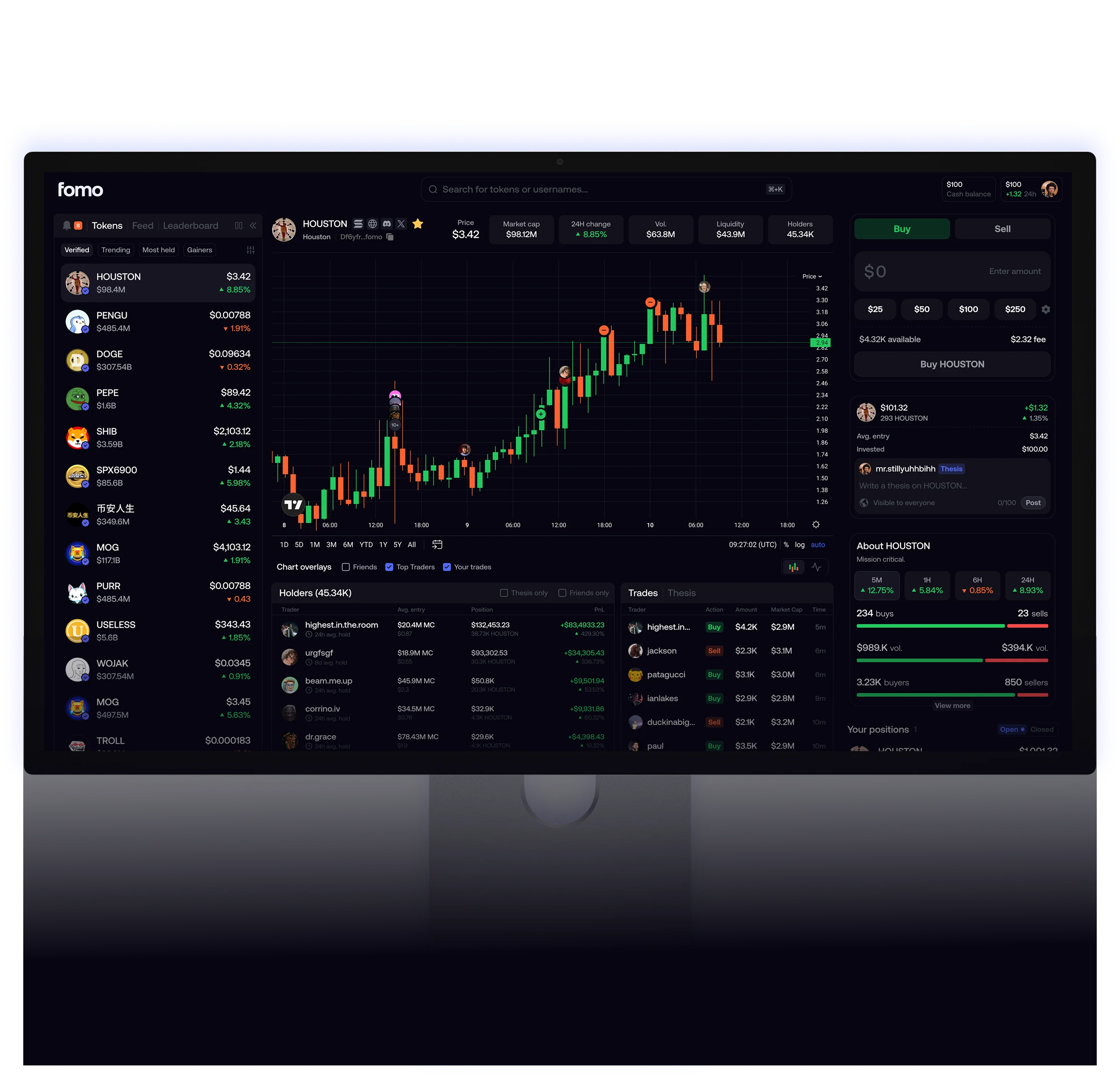
Fomo puts trader activity, token discovery and trading in one place. You can see what someone bought and their reasoning, open the token page, and check a quote without switching between several apps. One cash balance works across supported chains, while the same account follows you from phone to desktop. It suits people who want to research traders and make their own memecoin trades.
Need help with a failed sale? Use the sell troubleshooting guide.
What is Fomo useful for, and who is it for?
Finding a memecoin often means spotting a post, locating the contract, opening a chart and switching to a wallet. Fomo shortens that path: a trader’s public activity can lead you straight to the token, their reasoning and a trade quote. You get more context than a list of today’s biggest gainers.
It also simplifies multichain trading. Fomo currently supports Solana, Base, BNB Chain, Monad, Ethereum and Robinhood Chain through one cash balance. You do not manually bridge funds for each supported token purchase. Your account works on mobile and web, so research on a larger screen and checking a position on your phone can be part of the same workflow.
That makes it useful if you want to build a watchlist, observe traders and place your own trades. If you prefer direct control over wallet interactions or already have a setup you understand, there is no need to replace everything. Our memecoin tools guide covers the different jobs a trading setup can perform.
One distinction matters from the start: Fomo currently does not offer automated copy trading. Following a trader, receiving a notification and submitting your own order are separate actions. This guide covers spot memecoins, not leveraged perpetual futures.
Get 10% off trading fees
Sign up through our link and check the referral code: chen_p10. Standard fees fall from 0.50% to 0.45%.
Applies to Fomo trading fees, not network fees, token taxes or slippage. Check the quoted fee for small orders.
How do you buy your first memecoin and sell it later?
Make sure you are on the spot token page, not Perps. A first trade can simply test the full funding, buying, selling and withdrawal path. It does not have to be a hunt for the next winner, and a lower percentage fee is not a reason to increase your test budget.
- Fund the accountCheck the asset, network and credited cash.
- Find the tokenMatch its full contract and chain.
- Review the buyCheck the output amount and all costs.
- Check settlementLook for the actual token balance.
- Review the sellChoose a partial or full exit.
- Check your cashWithdraw only after the sale settles.
Before confirming a buy
Choose Buy on the token page and enter your amount. Review the expected tokens received, Fomo fee, any network fee, price impact and warnings. Learn how a preset or quick-buy control works before using it; a shortcut may submit an order rather than opening the review you expected.
Price impact is the effect of your order on the pool price. Slippage is the change between the quote and execution. A slippage tolerance, where adjustable, permits a worse fill; it does not improve a trade’s expected return. Do not keep increasing it just to force a transaction through. Try a smaller quote or skip the trade.
After submitting, check your position and transaction history. A click is not a confirmed fill. If the result is unclear, inspect the transaction status before submitting again.
When selling
Open the position, choose Sell, and select the amount or percentage to exit. Review the new cash quote before confirming. The displayed position value is not a guarantee of how much a sale will return.
Check the resulting cash balance and realized PnL. A partial sale leaves exposure, and a tiny remainder may fall below the in-app minimum: generally 2 USDC, or 5 USDC on Ethereum. High network fees can make even a slightly larger balance uneconomic to route.
Why not make every trade a brand-new launch?
A fresh token can make its first visible price feel like your last chance. By the time it reaches a trending list, though, other participants may already have completed their first buys.
Their starting points can differ. Creators or early allocations may have a much lower cost basis, bots can submit orders faster, and a prominent trader’s entry may attract followers who buy later. The useful question is not your place in a fixed queue. It is who already holds supply, why they hold it and who might sell into your order. Not every launch has the same structure, but a low market cap answers none of those questions.
One alternative is to watch a token through its first rally, selling wave and loss of attention before deciding whether it deserves more research. You may miss the earliest move. In return, you gain some history of ownership, trading and available liquidity.
Your schedule matters too. If you check prices a few times a day, a news trade that plays out in minutes may be a poor fit. Tokens with a trading history give you more to examine than a countdown and a promise. Start by identifying what might attract the next buyer.
Three meme categories: event, meta or community?
Two memecoins can attract buyers for entirely different reasons. Classifying the reason helps you decide what to watch after an entry; it is not a ranking of good and bad tokens.
| Category | What attracts buyers | What to watch while holding |
|---|---|---|
| Event-driven | A celebrity remark, news story, viral animal or video | Whether the event is still spreading, new people are arriving and demand survives the headline |
| Meta or mechanism-driven | Fee-sharing designs, a new launchpad, identity tokens or copies of a successful idea | What the mechanism actually does, whether usage lasts and whether attention stays with a leader or moves to the next copy |
| Community-led | A recurring meme, shared identity and participation people sustain themselves | Activity without fresh news, participation through drawdowns and liquidity that remains after the initial excitement |
A token created around a celebrity remark starts as an event trade. If people are still creating, organizing and trading weeks after that remark is forgotten, a community may be developing. A category can change; age alone does not create a community.
Event trades depend heavily on timing. Meta trades require an understanding of the mechanism and its competitors. Community-led tokens offer a longer history of participation to study, but that history does not establish that early holders have exited or that the next drawdown will recover.
How do you find an emerging community worth watching?
Look for reasons people stay after the first wave of excitement, not just the loudest chat. A short watchlist followed over time can teach you more than adding every token on today’s trending page.
| Signal to investigate | What to examine | What it helps distinguish |
|---|---|---|
| Life after the first catalyst | Trading and discussion after the original event and initial price decline | A one-off headline from continuing participation |
| Changing ownership | Holder counts over several days alongside concentration, airdrops and wallet splitting | Broader participation from a larger address count alone |
| Early supply moving | Sales by known team or early large wallets; do not label every transfer a sale | Where further selling pressure might come from |
| Participation through a drawdown | Trading, usable exit liquidity, discussion and organizers who remain active | A community from enthusiasm that appears only on green days |
| Attention without fresh news | New contributions, activities and participants rather than repeated calls from the same accounts | Interest that can recur without another headline |
| How key traders participate | Holding periods, reductions and successive theses on Fomo | Continuing engagement from short-lived flipping |
Fomo is useful for public trader behavior and reasoning. TradingView or Dexscreener can help with a longer chart view, while the relevant chain explorer is the place to inspect addresses and token distribution. Fomo’s Most held list is not a chain-wide holder count.
For example, a flat price alongside broader ownership, continuing trading and discussion without a new headline is worth investigating. A rising address count with disappearing liquidity tells a different story. A watchlist is not a buy list: your entry price and order size still matter.
How do you find memecoins without just chasing the trending list?
If you already have a token in mind, use Search with its full contract address and check the chain. A name, logo or verification badge is not enough to distinguish a token from a copy.
If you are exploring, use each discovery filter for the question it actually answers:
| Filter | Useful for | Does not establish |
|---|---|---|
| Trending | Tokens trending on Fomo, weighted by trading volume | Net capital inflows or future returns |
| Most held | Tokens widely held by Fomo traders | Independent owners or healthy concentration |
| Graduated | Tokens recently completing a bonding curve | A security audit or endorsement |
| Gainers | Tokens already showing large percentage gains | That those gains remain available to a new buyer |
| Starred watchlist | Tokens you chose to monitor | A portfolio vetted by the platform |
Add an interesting token to your watchlist before deciding to buy it. Then work through three questions:
- Why are people interested now? A news event, a new mechanism and a long-running community have different reasons to attract attention. If the catalyst passes, what keeps people interested?
- Can your position exit? Examine liquidity, large-holder concentration and the quote for your intended size. Market cap is a valuation, not cash available for sellers. A $100 trade can have very different price impact in two pools.
- What would make you walk away? Contract restrictions, unusual control, concentrated holdings or shrinking liquidity matter more than an enthusiastic chat. A Verified badge means a platform review, not guaranteed liquidity, future availability or returns.
Why look at the share of supply held on Fomo?
If the token page displays the share held by Fomo users, it can indicate how closely that token connects to the traders you can observe on the platform. For someone researching through Fomo, that connection may be more informative than market cap alone.
The same percentage can represent many continuing participants or a few large accounts. Ask who holds it, how long they have held, whether they are adding or reducing, and whether you understand the style of those traders.
An increase may also reflect transfers into Fomo rather than new buying. Combine the percentage with actual trades, concentration and an exit quote. 30% Fomo-held supply is not a universal buy signal; a high share can also produce a crowded exit.
How should you read the leaderboard and trader profiles?
Open Leaderboard from the friends area and compare 24-hour, 7-day, 30-day and all-time views. A profile lets you examine positions, trades and theses before following. The Friends only feed is useful for watching a manageable set of traders rather than reacting to every change at the top of the daily ranking.
Four checks make a profile more useful:
- Where did the profit come from? One unsold position can dominate a result. Rankings include realized and unrealized PnL; a marked-up holding is not money already withdrawn.
- How long does the trader hold? A strategy measured in minutes is not something you can reliably copy when you check your phone twice a day.
- What do losses and exits look like? Review sells, losing trades and remaining exposure, not just impressive entries. Win rate alone says little about the size of the occasional loss.
- Is your entry still comparable? A buy at $0.01 followed by your entry at $0.012 gives you a 20% higher cost. Buying the same token is not receiving the same trade.
A public profile is also not a complete picture of someone’s finances. Other wallets, private deals or hedges may sit elsewhere. Their dollar position size is not a sensible default for your account.
Follow tracks activity. Send transfers money. Neither starts automatic copy trading. Never send funds to a trader to “activate” copying. To act on an idea, open the token page yourself and reassess its current quote and costs. Fomo’s current copy-trading help article explicitly makes this distinction.
How can public trades affect the market you see?
Social trading places a stated view beside an actual position. Public entries and reductions let you compare a trader’s actions with what they wrote at the time, giving more context than an isolated profit screenshot.
It can also speed up attention: a visible buy sends people to a token page, some of them buy, and the resulting activity attracts further viewers. That is a possible feedback loop, not a claim that every public purchase creates additional liquidity.
After seeing a prominent account buy, the useful next step is to read the thesis and compare its timestamp with the current quote. The trader may still be adding, or may already be selling by the time you arrive.
Why research launchpad tokens instead of every new launch?
Another approach changes the question from “Which new token wins today?” to “Which platform keeps the business generated by these launches and trades?” You are studying recurring platform activity and how, if at all, its token benefits rather than trying to pick every successful meme.
The proposed link is launches and trading → platform revenue → an allocation such as buybacks → an effect on token supply and demand. Each step needs to work. A busy platform alone is not a reason its token must appreciate.
For a concrete example, the official PUMP token page describes open-market buybacks followed by burns. Researching this type of token means asking four questions:
- Where does revenue come from? Is it trading activity that might persist, or a temporary campaign?
- How does it reach the token? Examine the stated buyback, burn or other mechanism and whether it operates. Platform revenue is not automatically a distribution to holders.
- What happens to supply elsewhere? Unlocks, new circulating supply and large-holder sales may offset demand from buybacks.
- How much success is already priced in? A useful platform can still have an expensive token. Revenue growth without valuation context is incomplete.
Our PUMP, PONS and STONK pages explore different mechanisms; do not assume they share the same revenue allocation. A launchpad token is not a share in the company, and researching the platform does not remove exposure to the meme market.
When should you sell or rotate? A worked example
Rotation moves some or all of a position from A into B. The question is not simply whether A has rallied and B has fallen. It is whether B offers a better reason to take risk at today’s prices than continuing to own A. Cash is a third option.
First check whether the opportunities are comparable
Suppose A and B are both on your community-token watchlist. A has recently tripled; B is near the lower end of its previous range. That is a starting observation, not a reason to switch by itself.
Why has B lagged? Attention may have moved elsewhere, or its community may be leaving, early holders selling and liquidity shrinking. Why has A rallied? It may be chasing, or something may have changed enough to update your original view. The bottom of an old range is a historical location, not a floor under the next price.
On Fomo, look for repeated reductions in A and purchases of B among traders you follow, then compare their explanations and timing. Those public records can show individuals rotating; they do not establish a market-wide capital flow. Proceeds from A may stay in cash, while a purchase of B may come from a new deposit.
Compare holding A, switching to B and holding cash
Assume your A position is worth 1,000 USDC now. The table compares hypothetical price changes over the next period, before fees, slippage, network costs and risks of the cash asset itself. It is not a backtest or a forecast.
| Hypothetical next move | Keep A | Switch fully to B | Hold cash |
|---|---|---|---|
| A falls 30%; B rises 40% | 700 USDC | 1,400 USDC | 1,000 USDC |
| A rises 60%; B rises 10% | 1,600 USDC | 1,100 USDC | 1,000 USDC |
| A falls 30%; B falls 50% | 700 USDC | 500 USDC | 1,000 USDC |
The first row shows the benefit of a correct rotation. The second shows the cost of leaving a stronger token too early. The third shows why a laggard can keep falling. No probabilities are assigned to these outcomes, so the table cannot establish a win rate or expected return.
Real comparisons must subtract the costs of each path. Switching means selling A and buying B; moving to cash requires the sale of A; holding A avoids those immediate trades. If both the sale and purchase happen to be 1,000 USDC and qualify for the 0.45% discounted standard rate, the two platform fees total about 9 USDC before other costs. Smaller trades and thinner pools can change the comparison further.
When is not rotating the clearer decision?
- B’s only attraction is that it has not rallied. Without participation, a specific catalyst or better trading conditions, a lower-looking chart is not a thesis.
- A’s thesis still holds and B just appeared on the trending list. A new leaderboard winner does not require a change to your portfolio.
- Both depend on the same buyers. Changing tickers may not reduce risk in a broad sell-off.
- Neither opportunity is clear. Reducing exposure or holding cash can be more consistent with that assessment than forcing a choice between two tokens.
You do not have to sell all of A and put everything into B. A partial adjustment reduces dependence on one decision point, but leaves exposure to both tokens and still incurs costs. Before trading, state why you are switching, what would invalidate the decision and how much loss you can bear. A planned stop price does not guarantee an executable exit.
How do you sign up and use a referral code?
Start at Fomo’s official website to use the web app or download the mobile app. Register with the Apple ID or Google account offered on the signup screen. Fomo creates a non-custodial wallet for you; you do not need to bring a Phantom wallet or write down a seed phrase first. Keep using the same login identity when you change devices.
Use referral code chen_p10 at signup for 10% off eligible trading fees. The standard 0.50% rate becomes 0.45%; it is a discount on the fee, not a 10% reduction in the token’s purchase price. Even when arriving through a referral link, check the code on the signup screen.
There is no self-service code field afterwards. If a referral link did not attach correctly, use Profile → Settings → Help and Support → Contact Support. The current referral policy also allows support to change an existing referrer. Confirm the account result rather than assuming a request has taken effect.
How do deposits work, and which network should you use?
Already have crypto in a wallet or exchange?
Open Deposit → Crypto, select the network your funds are on and copy the displayed address. On the sending platform, select the same asset and network. Base USDC should go to the Base deposit route; an address beginning with 0x does not make every EVM network interchangeable.
| Deposit network | Standard funding asset | Current crediting minimum |
|---|---|---|
| Solana | USDC | No minimum stated by Fomo |
| Base, BNB Chain, Monad | USDC | 0.50 USDC |
| Ethereum | USDC | Currently 15 USDC; recheck before sending |
| Robinhood Chain | USDG | 0.50 USDG; converts to the USDC cash balance |
Make the first transfer small, but large enough to clear the destination minimum after any sending fee. Funding requires the correct network; buying supported tokens inside Fomo does not require you to bridge manually. Do not substitute SOL, ETH or USDT for the asset requested on the deposit screen.
Want to pay by card instead?
The Deposit screen may offer Crypto, Apple Pay, Debit Card, and Exchanges and apps. Not every account or region gets every method. The debit-card route funds your cash balance with USDC; Exchanges and apps can take you through Coinbase’s onramp.
Apple Pay needs a closer look. One route purchases a chosen token directly, rather than adding cash. The debit-card funding screen may also let you pay using a debit card saved in Apple Wallet. Check whether you will receive a token or a cash balance, plus the payment-provider fee and exchange rate, before confirming.
What does Fomo charge, and why can a small trade cost more than 0.5%?
Fomo charges on both buys and sells. The following spot schedule was checked against the official fee guide on September 26, 2026. The current order preview determines your actual fee.
Ordinary Solana tokens: order-size bands
| Order size | Platform fee before referral benefits | Example |
|---|---|---|
| Below 5 USDC | Flat 0.10 USDC | A 2 USDC order has a 5% effective fee |
| 5 to below 47.50 USDC | 2% of the order | A 10 USDC order costs 0.20 USDC |
| 47.50 to below 190 USDC | Flat 0.95 USDC | A 100 USDC order has a 0.95% effective fee |
| 190 USDC and above | 0.50% | A 1,000 USDC order costs 5 USDC |
A small test can be useful without being cheap in percentage terms. It also does not tell you the rate for a larger order. Do not increase exposure simply to reach a different fee band.
Other chains, the referral discount and extra costs
The standard fee on Base, BNB Chain, Monad, Robinhood Chain and Ethereum is 0.50% per trade plus network fees. Selected major tokens display a reduced 0.05% rate with small-order minimums; that is not the default for memecoins.
The referral benefit reduces eligible Fomo trading fees by 10%, bringing the standard rate to 0.45%. For an illustrative 1,000 USDC buy and a separate 1,000 USDC sell, both qualifying for that percentage rate, combined platform fees fall from 10 USDC to 9 USDC. Your actual sell notional will vary; check the quote for small-order rules, rounding and other costs.
Fomo covers Solana network gas, priority fees and token-account rent for trades. Other chains charge network fees separately. Token taxes, liquidity-pool costs and price impact are not covered by the referral discount. Two lines in a fee summary may therefore be the platform fee and the network fee, rather than a duplicate charge.
Count the entire round trip. Twenty buys and twenty sells, each for 1,000 USDC at a 0.45% platform rate, cost 180 USDC before other costs or price changes. A rotation strategy has to overcome those costs; a convenient app does not make frequent trading profitable.
How can repeated trading consume the balance?
Consider a cost-only model: start with 1,000 USDC, trade the entire remaining balance each round trip, assume unchanged prices and deduct a fixed percentage of the balance at the start of each round.
| Assumed total cost per round trip | Balance after 100 round trips |
|---|---|
| 2% | 132.62 USDC |
| 4% | 16.87 USDC |
| 6% | 2.05 USDC |
| 10% | 0.03 USDC |
The calculation is 1,000 × (1 − cost per round trip)¹⁰⁰. These are hypothetical all-in costs, not Fomo’s quoted fees or a universal slippage rate for small-cap tokens. They show how expensive repetition can drain a balance even without an adverse price move. The earlier 180 USDC example keeps each order’s notional fixed instead; the two models answer different questions.
How do you withdraw to an exchange, wallet or bank?
Withdraw your cash balance to a wallet or exchange
- On the receiving platform, open its deposit page and choose an asset and network it actually accepts.
- In Fomo, tap the three dots beside your cash balance, choose Withdraw → Crypto wallet, and enter the amount.
- Select the same network, paste the receiving address and review the output asset, amount and fees.
- For a new destination, test with an amount that clears both platforms’ minimums before moving the rest.
Standard cash withdrawals use USDC on Solana, Base, BNB Chain, Monad and Ethereum. On Robinhood Chain the output is USDG, so the destination must accept USDG on that chain. An exchange supporting USDC does not mean it accepts USDC on every network.
Withdrawing cash is different from moving the memecoin itself. For the latter, read Fomo’s token-transfer instructions. Do not send a memecoin to a deposit route that asks for USDC.
Bank withdrawals are not available to everyone
The documented bank route is for US bank accounts and requires identity verification. Regular withdrawals generally take 1–3 business days; faster routes have separate fees, bank requirements and timing conditions. Outside that scope, use an available crypto withdrawal route. Do not assume every local bank account is supported because the app works in your country.
Is Fomo safe, and who controls the wallet?
Fomo uses non-custodial wallets tied to your login. Its official security documentation describes split private keys and protections including Face ID on iPhone. Non-custodial describes control over assets; it does not remove token, execution, account-security or device risks.
Protect the Apple ID or Google account used at signup with strong authentication, and keep device biometric protections enabled. Use fomo.family for the product and help.fomo.family for help. Enter support through the app rather than a direct message from someone claiming to work there.
Social trading is public-facing: platform trades and theses appear in feeds and profiles. Fomo is not a way to hide trading activity. Conversely, a visible profile is not proof that you can see all of that person’s wallets or risk.
Normal trading does not require giving anyone your private key. Exporting a key for an advanced transfer or recovery exposes control of the wallet: never share it, upload it to an online utility or send a screenshot to “support.” Unexpected airdrops can show a large apparent value while being impossible to sell.
What should you do when a deposit or trade goes wrong?
| Problem | First check |
|---|---|
| The sender says complete, but no cash appears | Check the asset, actual network, receiving address and chain confirmation, then the deposit minimum. Reopening the app does not fix a below-minimum deposit. |
| Funds arrived on an unsupported EVM network | Confirm they are at your own Fomo address. Some cases can be accessed through the official export-and-recovery process; a wrong address is a different problem. Do not pay a recovery service from a DM. |
| Buy or Sell is unavailable | Expand the warning and read it. Acknowledging a label can enable the interface; it cannot override a honeypot or other restriction in the token contract. |
| A small holding cannot be sold or seems missing | Check the sell minimum, available quote and Hide dust setting. Hiding a position does not delete its tokens. |
| A card was charged but no funds arrived | Check whether it was an authorization, completed purchase or failed payment, and contact in-app support before repeatedly retrying. |
For support, share the transaction hash, network, amount and approximate time, not a private key. If the transaction state is unclear, pause before adding another transaction to the problem.
More Fomo questions
Is Fomo an app or a cryptocurrency?
This guide covers the social trading app at fomo.family, not a token with the ticker FOMO. Start from that official domain for the web app or download link; similarly named tokens and websites are not the same product.
Can I import my existing Phantom or MetaMask wallet?
No. Fomo creates a new wallet when you register and does not currently let you replace it with an existing wallet. Transferring funds into your Fomo wallet is different from importing a private key.
Can I add or change a Fomo referral code after signing up?
There is no self-service field after signup. If a referral link did not attach a referrer, contact support through Profile → Settings → Help and Support → Contact Support. The current policy also allows support to change an existing referrer. A request is not confirmation that the account has been updated.
Can I deposit USDT instead of USDC?
Do not send USDT to an instruction that asks for USDC. This guide uses the documented USDC route, or USDG on Robinhood Chain. Only use USDT when your current deposit screen explicitly offers that asset on the network you intend to send from; do not assume TRC-20 is supported.
Does Fomo have price alerts for spot memecoins?
The current notification guide says there are no arbitrary token-price alerts for spot or memecoin holdings. You can receive activity notifications for followed traders. Take-profit, stop-loss and liquidation-price alerts described for perps are a separate feature.
Why is my balance empty after changing phones?
Check that you used the same Apple ID or Google account you originally registered with. A different login can create a separate account. An empty new profile does not establish that the original wallet lost its funds; do not deposit again just to test recovery.
Why can I not sell the small amount left in a position?
The in-app minimum sell is generally 2 USDC, or 5 USDC on Ethereum. High network fees can make slightly larger positions too small to route as well. Hide dust removes small or unpriced holdings from view, not from your wallet. Adding to a position just to clear dust can cost more than the dust is worth.
Why did my portfolio chart fall after a withdrawal?
The profile chart tracks cash plus the current value of holdings. Removing funds reduces that account value; it is not necessarily a trading loss. Review the individual position's realized and unrealized returns to understand the trade.
Can I transfer the memecoin itself to another wallet?
Cash has an in-app withdrawal flow. For other tokens, the current official instructions use a private-key export into a compatible wallet to access the same address. This is different from withdrawing cash. Read the official instructions first and never give a key to support or a recovery service.
Can I use Fomo on the web if I cannot find the app?
Fomo has a web app with the same account and balance. Website access does not establish eligibility: platform restrictions, payment-provider availability and perps access are separate. Check current restrictions and use the same login identity as on mobile.
Official help and further reading
- Account creation and login
- Supported chains
- Funding methods
- USDC and USDG deposits
- Token discovery filters
- PUMP buyback and burn explanation
- Leaderboard
- Copy-trading availability
- Understanding PnL
- Current trading fees
- Referral codes and discounts
- Exchange withdrawals
- Bank withdrawals
- Wallet security
- Failed trades and contract restrictions
- Missing deposits and minimum amounts
- Small positions and minimum sells
- Notifications and price alerts
- Moving tokens to another wallet
- Existing wallet imports
- Availability and restrictions